Basic inserts and their triggers
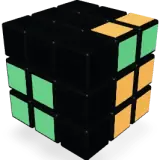
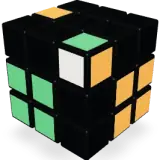
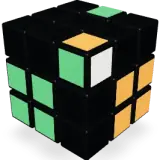
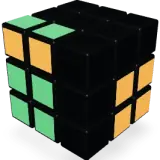
Most F2L cases end in a short insert from one of three sides: R U' R' from the right, its mirror L' U L, or F' U' F through the front. The edge's orientation decides which face inserts the pair.
Longer solutions are built from the same triggers. U R U' R' adds one setup move before the insert, and the sequences for a twisted or an already-solved corner repeat a trigger to take a piece out before returning the pair.
The example solutions in the Guided F2L lessons are standard CFOP algorithms, so the moves you watch are the moves worth memorizing.
A useful repetition order
- Describe the locations of the four corners and edges before turning.
- Choose a pair order and keep checking that the cross is still solved.
- Replay the scramble one move at a time when a piece path is unclear.
- Open the same link and try starting with a different pair.
How the trainer builds and solves cases
What black stickers mean
F2L is not an upper-face solving step. The center, edges, and corners that started in the U layer stay black wherever they move. Every other piece keeps its color, so target pieces remain visible when they enter the upper layer.
How random cases are generated
CubeDojang scrambles the whole cube first, solves only the cross, and then gives you the resulting F2L state.
- Scramble the whole cube with a long sequence that never turns the same face twice in a row.
- Solve only the cross in that scrambled state.
- Accept the case only when the cross is solved and all four F2L pairs are broken.
- Show both the scramble and the cross solution so playback matches the real state.
Solution methods in the trainer
Applying a scramble shows the pair-by-pair CFOP technique solution by default. Like a human solver, it keeps the cross and finished pairs intact at every step.
The fast near-optimal method uses a weighted heuristic search to find a solution usually within a few moves of optimal almost instantly, and from there you can run the optimality proof to check it against the HTM optimum. Search solutions may temporarily break the cross mid-sequence; only the final first-two-layers state is guaranteed.
When the search exhausts its budget it honestly reports a best-found solution instead of claiming optimality.


